What to Do If a Child Swallows a Pill or Edible: A Family Emergency Guide
The first ten minutes after a toddler swallows a pill, an edible or a grandparent's medication: what to do, what never to do, and when it is a 911 call.
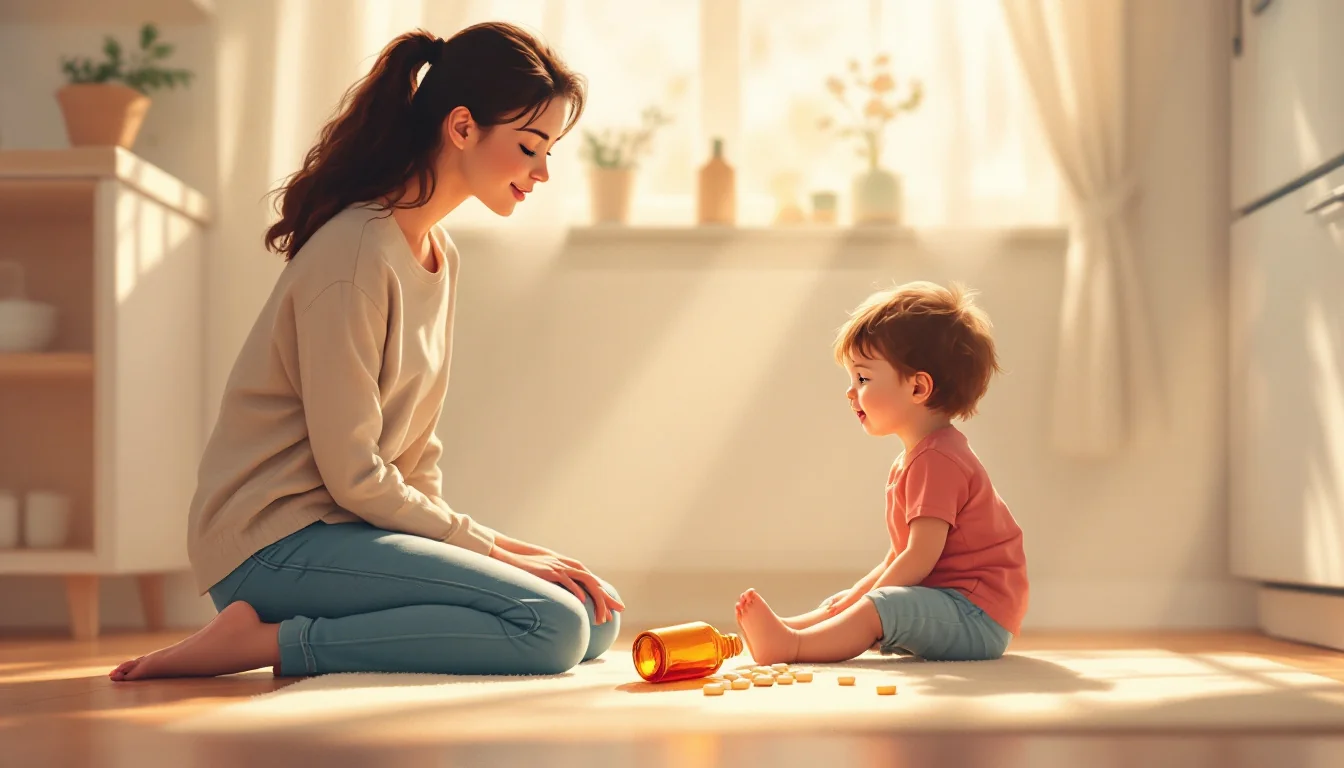
There is a specific kind of silence in a house where a child has just gotten into medication. A parent turns around from the sink, sees an open bottle on the floor, sees a two-year-old with something in their mouth, and the whole day narrows to one question: how bad is this?
The argument that follows is almost always the same. One parent wants to drive to the emergency room immediately. The other wants to wipe the child's mouth, watch for a few minutes, and see whether anything happens. Both parents love the child. Both are guessing, because nobody taught them this.
This guide is the part nobody teaches. It covers the first ten minutes, what the poison centers actually want you to do, why a child's body turns a small amount of medicine into a large dose, which substances change the plan, what happens in the emergency department, and how to make the next time less likely.
First decision: is this a 911 call or a poison center call?
There is a clear line, and it is about the child's breathing and level of consciousness, not about the pill.
Call 911 immediately if the child has collapsed, is having a seizure, is having trouble breathing, or cannot be woken up. That is the threshold the National Capital Poison Center sets on its first-aid page, and it is unambiguous.
Otherwise, call Poison Help at 1-800-222-1222. This is the national number that routes to the poison center serving your area. There are 53 poison centers taking human exposure calls in the United States, and a nurse or pharmacist poison specialist answers. The service is free, confidential, and available 24 hours a day. There is no such thing as a call that is too small; the centers say so directly.
If you cannot call, or do not want to wake a sleeping child by talking on the phone, there is an online option. webPOISONCONTROL, run by the same poison center system, walks through the substance, the amount, the child's age and weight, the route, the symptoms and the time elapsed, and returns a recommendation in a median of about two minutes and sixteen seconds. Across its cases, it tells roughly 72 percent of people to stay home, about 24 percent to call a poison center, and under 4 percent to go straight to an emergency room.
Two things follow from that. First, most of these calls end at home with instructions. Second, the tool is not a way to avoid getting help — it is a way to get an expert's answer in the same few minutes you would otherwise spend arguing in the kitchen.
The single most important instruction on either path: do not wait for symptoms to develop. Symptoms are a late signal. The poison center's whole value is that it can tell you what is likely to happen before it happens, based on the substance and the amount.
The two minutes that decide the rest of the call
The quality of the advice you get depends on the quality of the information you hand over. The poison center publishes the exact list of what its specialists ask. Gather it before or while you dial.
- The child's age, exactly. Not "almost three." Months matter here.
- The child's weight. Do not guess. If there is a scale in the house, use it. If there is not, say whether the child is smaller or larger than average for their age.
- The exact name of the product, read from the label. Similar-sounding medicines differ by a few letters and by a lot of pharmacology.
- The size of the container as it was sold — the number of pills, or the volume in ounces or milliliters. A half-empty bottle still needs its full size reported.
- The strength, in milligrams, milligrams per milliliter, or percent. This is the number that turns "he ate one" into a dose.
- When it happened, and how long the exposure lasted.
- How much was involved, if you actually know. Do not estimate and do not round up or down to sound better.
- Your name, phone number, relationship to the child, and the address. The callback number matters because follow-up is part of the service, and because calls drop.
Keep the container. Do not clean up the floor before you have it in your hand. Bring it to the phone — the label is the single most useful object in the room.
And if you genuinely do not know whether the child swallowed anything, say that. The poison center's own example of a normal call is a parent reporting that a three-year-old pulled a grandmother's medicine pack out of a suitcase, had a couple of pills in his mouth, and may or may not have swallowed them. That is a call they take every day.
Four things not to do
Do not induce vomiting. Poison centers no longer recommend it, and ipecac syrup is no longer recommended at all. Vomiting does not reliably empty the stomach, and it turns a swallowed dose into an inhaled one.
Do not give milk or water to "dilute" the medicine — with one narrow exception. The poison center's guidance is to give a small amount of water or milk immediately only if the swallowed product is burning, irritating or caustic, and only if the child is conscious, not convulsing, and able to swallow. For a pill, that exception does not apply.
Do not wait to see what happens. Covered above, and worth repeating, because "he seems fine" is the most common and most costly mistake in this scenario.
Do not judge the situation by how the child looks in the first twenty minutes. Two of the most common pediatric ingestions in the current supply — edible cannabis and long-acting opioids — peak long after the swallow. A child who is playing normally at minute ten can be lethargic at minute ninety. That is exactly why the assessment is based on substance and dose rather than on appearance.
Why a child's dose is not a small adult dose
A 25-pound toddler and a 175-pound adult can swallow the same tablet. The tablet does not know the difference; the body does. Milligram per kilogram is the only arithmetic that matters, and it is why a single pill that is unremarkable for an adult can be a serious poisoning for a two-year-old.
The national data on this is stark. A 2026 analysis of National Poison Data System records counted 41,612 unintentional ingestions of recreational drugs in children under 6 between 2000 and 2024. Most were in children under 3 (57.6 percent), almost all involved a single substance (95.9 percent), and 96.4 percent happened in a residence — the child's own home or someone else's. Half the children had no or minor effects. Five percent had a major effect, and six died.
Age was not neutral inside that dataset. Children under 3 were 1.54 times more likely to have a major effect and 1.23 times more likely to be admitted to a critical care unit than children aged 3 to 5. The same exposure, in a smaller body, went worse.
The rate tells its own story. Unintentional recreational-drug ingestion in children under 6 rose from 1.05 per 100,000 in 2000 to 35.91 per 100,000 in 2024 — a 3,307 percent increase, with the steep climb beginning around 2013 and driven especially by edible marijuana and psilocybin products. Poison centers took more than 2 million exposure calls in 2023; roughly 829,000 of them, nearly 40 percent, involved children under 6.
The substances that change the plan
Opioids: methadone, buprenorphine, and whatever is actually in the pill
Opioid ingestions were only 2.8 percent of the pediatric recreational-drug cases above, but they were the most dangerous category in the dataset: children exposed to opioids were 2.60 times more likely to need a critical care unit than children exposed to the other categories combined.
A 2021 matched study compared 90 children poisoned with methadone against 30 poisoned with buprenorphine. Methadone was the more toxic drug in children: 20 of 90 methadone cases had apnea, against none of 30 buprenorphine cases. Methadone cases needed far more naloxone — a median initial bolus of 0.4 mg against 0.02 mg, and a median maintenance infusion of 14.4 mg against 2.4 mg. Intubation was needed in five methadone cases; every child in the study survived.
Buprenorphine behaved differently, and in a way that matters for parents. Buprenorphine cases were more likely to arrive fully unconscious — 3 of 30 were referred in as fully awake, against 28 of 90 methadone cases — but then had fewer complications during treatment. A buprenorphine film or tablet in a toddler is still a medical event, not a wait-and-see: a partial agonist that a stable adult takes once a day is a large dose for a small child.
For any suspected opioid exposure, naloxone is the right instinct and the right first action. NIDA's guidance is to give it to anyone showing signs of an opioid overdose or when an overdose is suspected; it has no effect on someone who has no opioids in their system, so being wrong is not dangerous. The signs it lists are unconsciousness, very small pupils, slow or shallow breathing, vomiting, inability to speak, faint heartbeat, limp arms and legs, pale skin, and purple lips or fingernails.
One trap: naloxone only works for 30 to 90 minutes, while many opioids stay in the body longer. A child can wake up, look normal, and go back down after the dose wears off. That is why naloxone is always paired with a 911 call, not used as a substitute for one.
Edible cannabis
Cannabinoids made up 84.7 percent of the pediatric recreational-drug ingestions in the 2000–2024 dataset — by far the largest category, and the one growing fastest.
A 2021 chart review of 32 pediatric edible ingestions at a tertiary care center found that severe symptoms — lethargy and respiratory depression — along with the need for respiratory support and hospital admission, were more frequent in younger children. Need for respiratory support was low in that series, but admission was common, and the authors noted exposures were occurring with increasing frequency over time.
The practical point families miss is timing. An edible is not a pill that acts in twenty minutes. Onset is delayed, the child can look entirely well for the first hour, and the peak arrives later. "He ate half a gummy and he's fine" is a statement about the last thirty minutes, not about the next four hours.
Counterfeit pills and fentanyl
Pediatric fentanyl exposures reported to poison centers rose from 69 in 2015 to 893 in 2023 — a 1,194 percent increase, according to a 2025 analysis of 3,009 nonfatal cases across 49 states. 41.1 percent of those children were aged 0 to 12. More than a third of the cases were unintentional and/or had documented life-threatening effects.
That is the reason a small round pill found on a playground, in a parking lot, or in an older sibling's room is treated as a possible opioid rather than as candy or as "probably a mint." You cannot identify a pressed counterfeit by looking at it. If a child has possibly swallowed an unknown tablet and becomes drowsy, give naloxone and call 911.
Stimulants and unknown powders
Stimulant ingestions were 8.4 percent of the pediatric cases in the national dataset, and they carried a 2.16-fold increase in the odds of critical care admission. There is no home antidote and no reversal agent — the management is monitoring, cooling, and treating agitation and elevated heart rate in a hospital. This is the category where the poison center's answer is most likely to be "go in."
What the emergency department will actually do
Parents often arrive expecting a stomach pump and leave confused that the child was simply watched. The watching is the treatment.
For an opioid exposure the team may give naloxone, monitor breathing continuously, and keep the child for hours after the last dose of naloxone because of the 30-to-90-minute window described above. For an edible cannabis exposure the team watches airway and breathing, because that is what the pediatric literature shows going wrong. For stimulant exposure the focus is heart rate, temperature, agitation and hydration. In the 2021 edible series, admission was more common than respiratory support — meaning many children were kept for observation rather than treated for a crisis.
Bring three things with you: the container, any remaining pills, and a list of every medication in the house. The last one sounds excessive until a child's altered mental state needs to be explained.
One more thing, said plainly. Staff will ask how the child got access. That question is about the child's safety and about what to change at home, and it is asked of parents in every income bracket and every kind of family. If your household is already involved with child welfare, or you are afraid of that, it is worth knowing how those investigations actually work before the conversation happens — our guide on CPS investigations and substance use covers it. Withholding information from a treating clinician is the choice that makes everything harder, and it does not protect anyone.
The twenty-four hours after "it is safe to stay home"
A "stay home" recommendation is not a shrug. It comes with a specific list: what to do, which symptoms are expected and when to expect them, which symptoms should trigger a call back to the poison center, and which symptoms mean go to the emergency room now.
Follow that list rather than a general impression. Write down the recommendations, the time of the exposure, and the poison center case number if you are given one, because a second call hours later is far more useful with those in hand. And use the callback: follow-up is part of how the service works, and a parent who calls back because breathing changed is doing exactly the right thing.
Prevention that actually holds after a scare
The uncomfortable finding in the national data is that 96.4 percent of these ingestions happened in a residence. This is not a story about dangerous strangers. It is a story about a house.
The 2026 dataset's steepest increases came from edible marijuana and psilocybin products — items that look like food, are frequently stored in kitchens, and are often bought by adults who never think of themselves as keeping drugs where a child can reach them. That category needs to be treated like medication, not like groceries: out of the kitchen, out of reach, out of sight, ideally locked.
Four changes that hold up in practice:
- Walk the house at toddler height. Kneel down and look at what is within reach from that position: nightstand, purse, backpack, the shelf above the sink, the suitcase in the guest room. The poison center's own illustrative case was a grandmother's medicine pack in a suitcase.
- Lock the high-risk items, and keep them labeled. Opioids, sedatives, stimulants, cannabis edibles and buprenorphine products first. Original containers with labels stay — they are also what you will be reading from during the phone call.
- Talk to visitors before they arrive, not after. Grandparents, houseguests and babysitters all carry medication. A single sentence — "we have a two-year-old who gets into everything, can you put your bag in the closet" — prevents most of these calls.
- Keep naloxone in the house and know where it is. NIDA notes that naloxone nasal spray is a needle-free, no-assembly device that is easier for people without formal training to use, and that families with a loved one at risk should have it nearby and tell friends where it is kept. For the storage and disposal side of this, our guide on safe medication storage and disposal goes step by step.
If the pills belonged to a teenager in the house, the conversation is a different one, and it is not primarily a punishment conversation. A sibling's stash that a toddler found is a safety problem first and a substance-use signal second — both need addressing, and the order matters, because a teenager who expects rage learns to hide the stash better rather than to store it safely. Our guides on talking to a teen about substance use and handling a relapse are written for that conversation.
Bottom line
Call 911 for a child who has collapsed, is seizing, is struggling to breathe, or cannot be woken. Call 1-800-222-1222 for everything else, immediately, with the container in your hand and the child's exact weight in your head. Do not induce vomiting, do not wait for symptoms, and do not assume that a child who looks fine at minute ten is out of danger.
Then spend fifteen minutes on the floor at toddler height, and change what you find there.
Where to get help
- Poison Help — 1-800-222-1222. Free, confidential, 24/7, routed to your regional poison center. Also available online through webPOISONCONTROL at poison.org.
- 911 for collapse, seizure, trouble breathing, or a child who cannot be woken.
- SAMHSA National Helpline — 1-800-662-4357. Free, confidential, 24/7, English and Spanish, for treatment questions and referrals.
- 988 Suicide & Crisis Lifeline — call or text 988.
- FindTreatment.gov — SAMHSA's treatment locator by ZIP code.
- Never Use Alone — 1-800-484-3731 for someone using alone who wants a voice on the line.
Sources
- America's Poison Centers / National Capital Poison Center — First aid: Act fast!
- National Capital Poison Center — Get help online or by phone (webPOISONCONTROL)
- Uskovich K et al. — Unintentional ingestion of recreational drugs among young children, 2000–2024, BMC Public Health 2026 (PMID 42343328)
- Farnaghi F et al. — Unintentional buprenorphine and methadone poisoning in children, Clinical Toxicology 2021 (PMID 33475438)
- Kaczor EE et al. — Cannabis product ingestions in pediatric patients, Journal of Medical Toxicology 2021 (PMID 34117620)
- Palamar JJ et al. — Nonfatal pediatric fentanyl exposures reported to US poison centers, 2015–2023 (PMID 40055875)
- NIDA — Naloxone DrugFacts
- SAMHSA National Helpline
You might also read