Safe Storage and Disposal of Prescription Medications: A Family Guide
Where leftover pills really come from, how to secure what stays in the house, and how to get rid of what doesn't — take-back, mail-back, or trash.
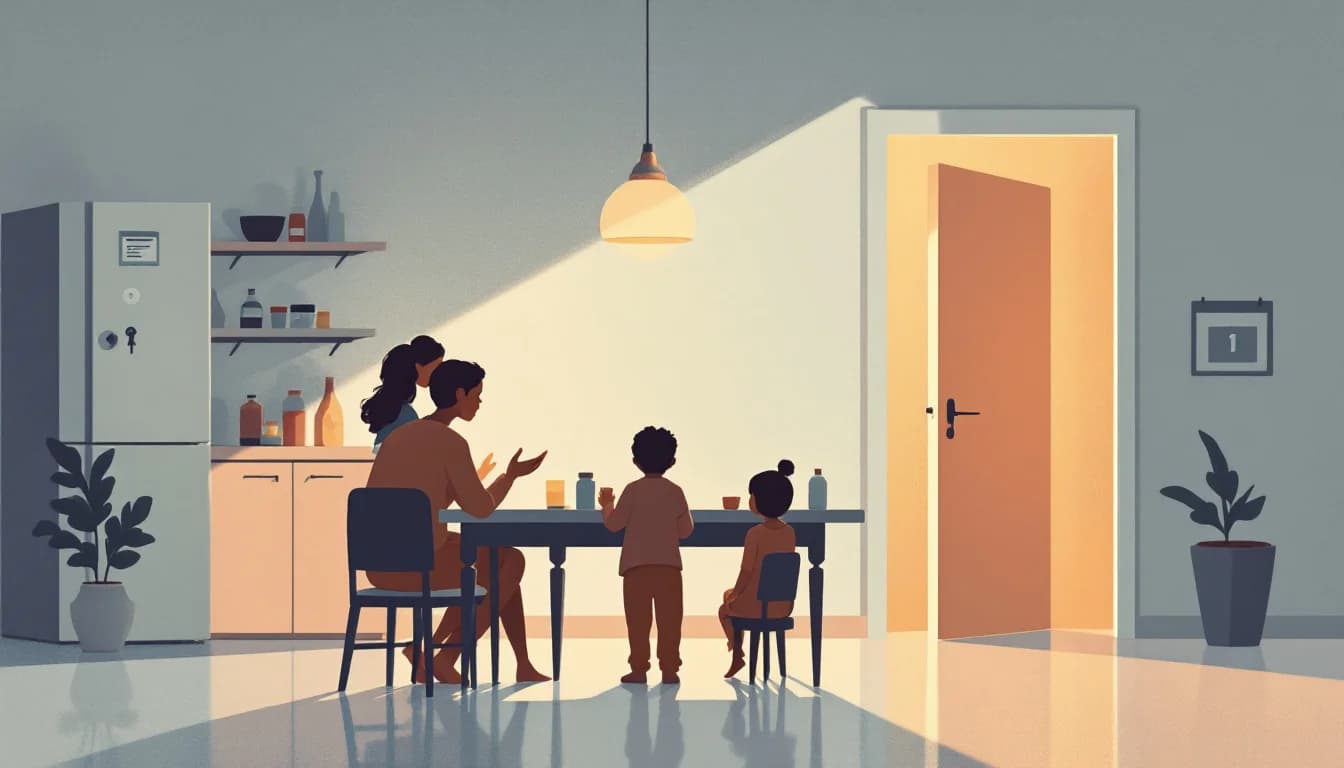
There is a drawer in almost every American home that nobody thinks about. It holds a half-empty bottle of pain pills from a root canal two years ago, a course of antibiotics someone stopped early, a relative's blood pressure medication that was switched, and a bottle of something expired.
Nobody thinks of that drawer as a supply. But it is. Public health agencies describe the home medicine cabinet as one of the main places that misused prescription drugs come from — pills taken from a friend's or relative's supply rather than bought from a stranger. The same drawer is also where young children and pets find their way into accidental poisonings, and where a teenager in a hard season can find something to take.
This guide is about two habits that most families were never taught: how to store the medications that stay in your home, and how to properly get rid of the ones that should not. Neither requires much money or any special knowledge. Both take about twenty minutes to set up.
Why this matters more than most families assume
The scale is hard to picture until you see the numbers.
Roughly four billion retail prescriptions are filled in the United States every year, and by one University of Michigan estimate cited by the EPA, almost every American household contains prescription or over-the-counter medications at any given moment. Opioid painkillers are a small slice of that total — in 2019, about 153 million opioid prescriptions were written, down sharply from a peak of roughly 255 million in 2012 — but that 2019 figure still worked out to an opioid prescription for 46.7% of all Americans.
What happens to those pills after the prescription ends is the part that surprises people. Surveys cited by the EPA have found that anywhere from about a third to the large majority of people keep their leftover opioid prescriptions rather than dispose of them, and a 2019 survey found 37% of respondents kept leftover prescriptions on hand for future use. The leftover bottle is rarely treated as a hazard. It is treated as a spare.
That spare supply matters for three separate reasons:
- Misuse. NIDA lists "taking someone else's prescription" as one of the core ways people misuse prescription drugs — and it is often a family member's or friend's bottle, not a drug dealer's.
- Accidental poisoning. CDC's medication safety program counts more than 1.5 million emergency department visits each year from adverse drug events, and its guidance for parents is blunt: lock the safety cap, and keep medicines where young children cannot reach or see them.
- Intentional risk. For a teenager in crisis and for some older adults, a drawer full of leftover opioids, sedatives and stimulants is not just a temptation — it is a means. Reducing what sits in the house reduces that risk.
None of this means families should be afraid of their own prescriptions. It means that a medication that is still active is still a medication, and should be treated with the same care whether the person it was prescribed to still needs it or not.
Know which medications deserve the most protection
Not every bottle needs a safe. But some medications deserve more protection than others, and it helps to know which.
Treat these as high-priority:
- Opioid pain relievers — including leftover pills after surgery, an injury or dental work.
- Benzodiazepines and other sedatives — the anxiety and sleep medications that are especially dangerous when mixed with opioids or alcohol.
- Stimulants — ADHD medications such as amphetamine- and methylphenidate-based products.
- Sleep medications and any medication that can cause dangerous drowsiness.
- Any medication that is lethal in small doses — the same short list the FDA flags for special disposal.
Treat these as routine but still worth controlling: blood pressure medications, antidepressants, muscle relaxants, and anything a child could mistake for candy.
Two practical rules follow from that list. First, the highest-risk medications belong in the locked container, not the open shelf. Second, if a household contains a person in recovery — or a person who is actively struggling — the calculus changes: a single accessible bottle can be the difference between an ordinary week and a relapse, or worse.
How to store medications safely at home
The EPA's storage guidance is refreshingly simple, and it does not require a dedicated product. The goal is a robust locking compartment — the agency specifically notes that a locked cabinet, closet, lockbox, fire box, gun safe or medicine safe all serve the purpose. What matters is that it limits access and resists tampering, not that it is marketed as a medicine safe.
A workable home setup:
- Designate one locked spot. A lockbox or locking cabinet in a room the household uses, not hidden in a closet nobody checks.
- Keep medications in their original, labeled containers. Original packaging carries the drug name, dose and instructions — the information you need in an emergency.
- Move the high-risk medications in first. Opioids, sedatives, stimulants and sleep medications go in the lockbox. Everything else can stay in a normal, out-of-reach cabinet.
- Put medicines back immediately. CDC's parent guidance is the one people skip: after locking the safety cap, put the medicine straight back in its safe storage location — not on the counter, not on the nightstand, not "just for now."
- Keep a written list. CDC recommends keeping a list of all medicines, vitamins and supplements, both for your own reference and so any clinician treating you knows the full picture.
- Sort out the leftovers. Everything past its expiration date, everything from a finished course, and everything nobody is currently taking should leave the house. This is the step most families never take, and it is covered in detail below.
- Re-secure when guests arrive. Grandchildren, houseguests, contractors and caregivers all pass through a home. A locked box does not care who is visiting.
One caution for families managing an older adult's medications: weekly pill organizers are extremely useful for adherence, but they are not secure — the entire week's supply sits in the open. Keep the master bottles in the locked compartment and refill the organizer from there.
What to do with leftover medications — the part most families get wrong
The single most common mistake is also the most understandable: putting the old bottle back in the drawer "in case." The second most common is flushing pills down the toilet or sink.
Both are wrong. The EPA's guidance is clear: use a drug take-back program whenever one is available, and do not flush medications down the toilet or drain unless no take-back option exists and the label or patient information specifically tells you to.
Option 1: Take-back programs (the preferred route)
There are two main kinds, and both are free.
DEA National Prescription Drug Take Back Day happens twice a year, in April and October, at thousands of local collection sites run with law enforcement. The next one is Saturday, October 24, 2026, from 10 a.m. to 2 p.m. Take-back days accept over-the-counter medications as well as prescriptions.
Year-round collection kiosks are the quieter, more convenient option. DEA-authorized collectors — often pharmacies inside retail stores or hospitals, and some police departments — keep permanent drop-off kiosks that frequently resemble mailboxes. A 2019 Government Accountability Office report cited by the EPA found that 71% of the U.S. population lived less than five miles from a permanent collection site, and that in 42 states at least half the population lived within five miles. Typing "medication disposal near me" into a maps app is often the fastest way to find one.
Option 2: Mail-back envelopes
Postage-paid, pre-addressed mail-back envelopes let you return medications through the mail for proper disposal. Many retail pharmacies sell them, and some retailers, community organizations and states hand them out free.
Option 3: Community take-back events
Local organizations and coalitions also run one-day collection events. DEA rules require law enforcement to be present at these events, so they follow the same chain of custody as a kiosk.
If no take-back option is genuinely available
Sometimes a rural household is hours from the nearest kiosk, or a storm closes the collection site. In that case, the EPA's household method is not complicated and does not require buying anything:
- Take the prescription drugs out of their original containers.
- Mix them with something undesirable — cat litter, dirt or used coffee grounds.
- Put the mixture into a disposable container with a lid, such as an empty margarine tub, or into a sealable bag.
- Conceal or remove personal information on the empty containers — cover the Rx number with permanent marker or duct tape, or scratch it off.
- Put the sealed container and the empty containers in the household trash.
Note that the amber prescription vials most pharmacies use are not recyclable in most of the country; check local rules before tossing them in a recycling bin.
Why take-back beats the trash every time
Take-back programs dispose of medications by incineration at permitted facilities with strict emission controls. That keeps pharmaceuticals out of groundwater and surface water — and, just as importantly, it gets them physically out of your home, where a locked box in a closet can still be found.
The flush list: the rare exception where flushing is correct
There is one narrow situation in which flushing is actually the right call. The FDA maintains a short "flush list" of medications that should be flushed only when no take-back option is available and when a child or pet could otherwise get into the trash.
The list is smaller than most people assume: it contains just 13 active ingredients, 10 of which are opioids — medicines placed there precisely because they can be lethal in very low doses. The EPA and FDA both stress that even for these medications, a take-back program is still the preferred method. Flushing is the fallback, not the default.
So the decision tree is short:
- Take-back available → use it. Always.
- No take-back, medication is not on the flush list → mix, seal, trash.
- No take-back, medication is on the flush list → flush.
Building it into a household routine
Storage and disposal only work if they become habits rather than projects. Two anchors make that easy:
- A home safety pass every six months. Tie it to the take-back calendar: the DEA's April and October events are a built-in reminder to clear the cabinet and drop everything off.
- A rule for new prescriptions. When a prescription is finished — or the reason for it has passed — the bottle leaves the house at the next take-back run instead of going back in the drawer.
It is also worth having one short conversation with your prescriber or pharmacist after surgery or an injury. Ask how many doses you will realistically need, whether a smaller supply is appropriate, and how to dispose of whatever is left when you are done. Fill what you need, not what fits the bottle.
Finally, if opioids are in the home, keep naloxone on hand and make sure everyone in the household — including teenagers and older children — knows where it is kept and how to use it. NIDA notes that nasal-spray naloxone is available without a personal prescription in many states and that friends, family and community members can use it to reverse an overdose. Having it is not an admission that something will go wrong; it is the same logic as a fire extinguisher.
If someone in the home is already at risk
Locking up medications is prevention. It is not treatment, and it is not enough on its own.
If a family member is misusing prescription medications — theirs or someone else's — the most important step is not a lockbox. It is a conversation with a clinician, and it is a well-established path that includes behavioral therapies and, where opioids are involved, FDA-approved medications such as buprenorphine and methadone. Medication for opioid use disorder is safe, effective and saves lives; NIDA is explicit that these medicines, taken as prescribed, are not interchangeable with misuse.
A few things families can do this week:
- Reduce access without humiliating anyone. "We are clearing out all the old prescriptions" is true, practical and non-accusatory.
- Do not give leftover pills to anyone, even for the same complaint. Doses, interactions and histories differ.
- Treat a relapse as information, not a verdict. NIDA's guidance is that relapse is a signal to adjust treatment, not proof that treatment failed.
- Protect the rest of the household, including children and pets, while the situation is being addressed.
Where to get help
- SAMHSA National Helpline — 1-800-662-HELP (4357), free, confidential, 24/7, in English and Spanish.
- FindTreatment.gov — SAMHSA's treatment locator for local options by ZIP code.
- 988 Suicide & Crisis Lifeline — call or text 988 for crisis support, including for family members.
- Poison Control — 1-800-222-1222 for any suspected accidental ingestion, in a child, a pet or an adult.
- DEA take-back sites — search "medication disposal near me" or use the DEA's authorized collector locator to find a year-round kiosk.
A medicine cabinet is a minor thing until it is the thing that gets someone hurt. Locking it down and clearing it out takes twenty minutes, costs almost nothing, and removes a risk that sits in plain sight in millions of homes — possibly yours.
Sources
- EPA — Safe Storage of Medicines in the Home
- EPA — What to Do with Unwanted Household Medicines
- EPA — The Limited Role of the FDA's Flush List
- DEA Diversion Control Division — National Prescription Drug Take Back Day
- CDC — Medication Safety and Your Health
- CDC — Preventing Opioid Overdose
- NIDA — Prescription Opioids DrugFacts
- SAMHSA National Helpline
You might also read