Adult Children of Parents With Addiction: A Guide to Healing and Boundaries
Growing up with a parent who struggled with alcohol or drugs leaves survival patterns that follow you into adulthood. What helps, and what to do first.
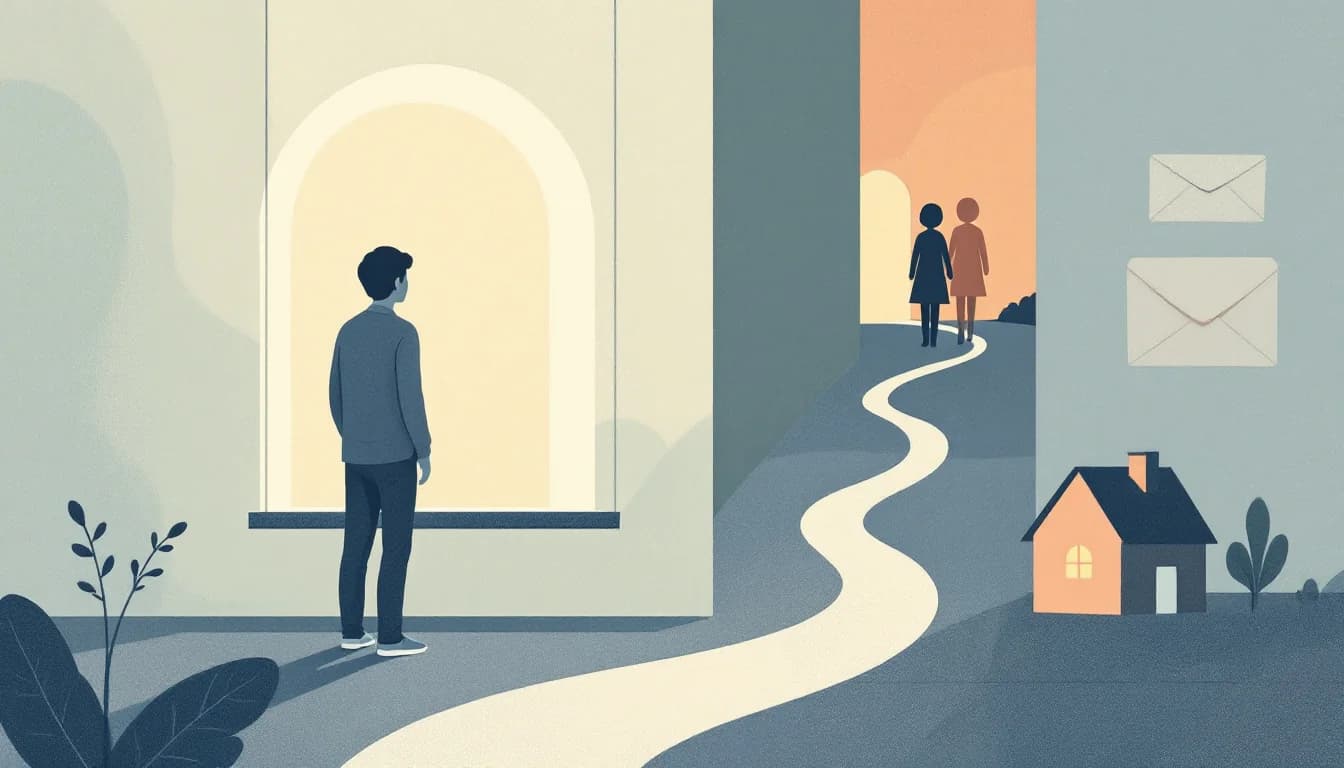
Most people who grew up with a parent who drank too much, or used drugs, can describe the childhood in more detail than they would like. What is harder to see is the second half of the story: how the habits that got them through that house are still running their adult life — the way they read a room before they say anything, the way they apologize for existing, the way calm feels suspicious.
This guide is for the grown children. It is not about your parent's recovery, and it does not require your parent to be part of anything. It covers what the research actually shows about adults who grew up this way, what the patterns look like when you finally name them, what helps, and how to decide what kind of relationship you can have with a parent who is still drinking or using — or who stopped years ago and never said much about it.
You are not a diagnosis, and you are not a forecast. You are someone whose early environment taught certain lessons very thoroughly, and lessons can be unlearned.
Why a Childhood You Did Not Choose Still Shows Up Now
The clearest evidence that this is real, and not a matter of being oversensitive, comes from the Adverse Childhood Experiences (ACE) study. Researchers surveyed 9,508 adults who had completed a standard medical evaluation and asked about seven categories of childhood exposure: psychological, physical, or sexual abuse; violence against a mother; and living with household members who were substance abusers, mentally ill or suicidal, or ever imprisoned.
Living with a household member who abused substances was one of the seven. More than half of respondents reported at least one category, and one in four reported two or more. The findings were graded: the more categories someone had lived through, the higher their risk as an adult. Compared with people who reported none, those who reported four or more had a 4- to 12-fold increase in health risks for alcoholism, drug abuse, depression, and suicide attempt.
Why unpredictability does more damage than any single event
What children in these homes adapt to is not only what happened, but not knowing what was coming next. Family systems and attachment researchers describe the same mechanism from a clinical angle: substance use disorder reshapes the emotional and behavioural patterns of a household from the very beginning, and children build their sense of safety around whatever the household actually does, not around what it should do.
So a child learns: track the mood of the room. Be useful. Be quiet. Do not need anything. Those are not character flaws. They are competent survival engineering, and they work — for a while, and only inside that house.
The Patterns Adult Children Recognize in Themselves
NACoA, the National Association for Children of Addiction, describes the adult version of this plainly. When home felt unpredictable, you may have learned to stay alert, avoid conflict, hide your feelings, take care of other people, or become highly responsible — and those responses can continue long after childhood.
As an adult, that can look like:
- Difficulty trusting people or asking for help. Needing help used to be dangerous.
- Feeling responsible for everyone else's well-being. You were the emotional adult in the room before you were old enough to drive.
- Trouble identifying, expressing, or regulating emotions. If feelings were a liability, you stopped practising them.
- Repeating familiar relationship patterns. Including choosing people who need managing.
- Discomfort when life is calm. Anticipating the next crisis feels safer than resting.
- Using work, food, alcohol, drugs, or spending to manage difficult feelings. The coping skill that was available is the one that stuck.
The checklist that makes people say "how did you know"
Al-Anon Family Groups, which has supported relatives of problem drinkers for decades, publishes a self-assessment for adults who grew up with a problem drinker. Its questions are worth reading in full, but the themes are unmistakable: constantly seeking approval, failing to recognise your own accomplishments, fearing criticism, overextending yourself, needing things to be perfect, feeling uneasy when life is going smoothly, still feeling responsible for others the way you once felt responsible for the drinker, caring easily for other people and with difficulty for yourself.
If several of those land, that is information, not a verdict. It means the patterns have a name and a shape, which is the only prerequisite for changing them.
What the Research Says About Your Risk
This is the part families most often get wrong in both directions — either "it is genetic, it is fate," or "it was years ago, it does not matter." The largest study on this is more useful than either.
Researchers used Swedish national registers to follow 99,723 people who had at least one parent with an inpatient diagnosis of alcohol use disorder, alongside 2,321,756 people with no such parental diagnosis, tracking them from 1973 to 2018. Risks were higher for every substance. Before adjustment, the highest risks were for other stimulant use disorder (hazard ratio 5.33), volatile solvents (4.95), and opioids (4.62).
Then the researchers adjusted — for the child's sex, parental education, parental death, parental substance use disorder, and parental psychiatric disorder. The risks fell, and they converged to roughly twice as high as the comparison group.
A companion study from the same registers looked at mental health rather than substance use and found a similar shape: adult children of parents with alcohol use disorder had about 2.3 times the risk of a mood disorder and 2.7 times the risk of an anxiety disorder, and after adjustment for sociodemographic factors and a parent's own mood or anxiety disorder, those dropped to 1.67 and 1.74. Risk was highest when both parents were affected, then when the mother was, then the father.
Read that adjustment honestly
Halving a risk with statistical adjustment is not a technicality. It says that a large share of the excess risk came from things that are not a fixed inheritance: family income, parental education, a parent's untreated mental illness, and the chaotic environment itself. Some of those are the conditions you can actually do something about, in your own life, now.
And an "elevated" risk is not "inevitable." Even the elevated figures describe a minority outcome, not a majority one. Most adults who grew up with a parent with a substance use disorder do not develop one.
What protects people, according to the data
A 2020 study followed 14,608 people born in Sweden in 1953 from birth to age 63. School performance at age 13 accounted for 58% of the link between parental alcohol misuse and the child's own alcohol misuse in adulthood — and the authors concluded that above-average school performance in children whose parents misused alcohol appears to reflect genuine processes of resilience that can break the intergenerational transmission.
The mechanism matters more than the metric. A capable adult, a structured activity, a teacher or coach who paid attention, a grandparent who was steady — any source of predictability and competence changes the trajectory. If you grew up without one, the point is that you can be that steady presence for yourself now, and it is not too late for it to change something.
The Role Nobody Names: Being Your Parent's Parent
Many adult children end up in a version of the job they held at nine years old. Your parent calls with a crisis, and you handle it. You are the one who notices the medical bill, the unpaid rent, the escalating drinking, the pills.
There is nothing wrong with helping. The problem is when the arrangement stops being a choice and becomes an assignment — when you are the only adult in the relationship, and being needed is the only form of closeness on offer. Therapy language calls this overdeveloped responsibility. NACoA describes detachment as a skill that can be practised, not an abandonment.
A useful question to ask yourself: if I set this down for one month, what would actually happen, and who would it happen to? If the honest answer is that your parent would face a consequence you are currently absorbing for them, you have found the boundary that matters most.
What Actually Helps
Therapy. Cognitive behavioural therapy and trauma-informed approaches are the most commonly used modalities for exactly this presentation — anxiety, hypervigilance, difficulty with boundaries, and grief that never got a proper funeral. If you are choosing a therapist, tell them in the first call that you grew up with a parent with a substance use disorder and ask whether they work with adult children from those homes. A specialist does not need to explain your childhood back to you.
Emotional sobriety. NACoA points to emotional sobriety work — learning to recognise feelings, regulate responses, and bring thoughts, feelings, and actions back into balance — as especially useful when old coping patterns are driving relationships or compulsive behaviour.
Medication, when a clinician recommends it. If you have developed your own anxiety, depression, or substance use disorder, that is a treatable condition in its own right, not a permanent character trait.
And the honest caveat: there is no single approach that works for everyone, and no therapy removes the past. What it does is replace a survival reflex with a choice. That difference is most of the quality-of-life gain.
Peer Support: People Who Already Understand
The oldest and most available form of help for adult children is other adult children — and it is free.
Al-Anon Family Groups. Al-Anon is for relatives and friends of people with a drinking problem, and its own membership survey found that more than half of members' lives had been affected by a parent's drinking. Al-Anon states that one in four children under age 18 in the United States is affected by a parent's abuse of alcohol — a figure worth holding on to, because it means the room you are imagining is not a small or shameful one. Meetings are in person, online, and by telephone, and there is a specific quiz written for adults who grew up with a problem drinker.
Adult Children of Alcoholics and Dysfunctional Families (ACA). ACA is a Twelve Step fellowship built for people who identify as adult children. It publishes the Laundry List, a set of common characteristics read at meetings; many groups hold "closed" meetings reserved for those who identify as adult children, with open meetings available to friends and relatives. It is spiritual rather than religious, and telephone and internet meetings mean geography is not a barrier.
Nar-Anon Family Groups serves the same role when the substance is not alcohol.
NACoA's adult-child education library offers recorded sessions on resilience, overdeveloped responsibility, detachment, parenting, self-forgiveness, and family patterns — useful if you are not ready for a room full of strangers.
Boundaries With a Parent Who Is Still Using
Boundaries are not punishment, and they are not a strategy for getting someone sober. They are the terms on which you can stay involved without disappearing. In practice they come down to a handful of decisions.
Contact. How often, in what form, and about what. A weekly short call is a legitimate relationship. So is a text-only relationship during active use. So is no contact — an option that is not a failure, and not permanent unless you decide it is.
Money. Money given to fund use is money that funds use. If you want to help, pay a provider directly — rent to a landlord, a bill to the utility, a treatment program to the facility — rather than handing over cash. This is the single boundary that most often keeps families intact.
Your home. Decide in advance what you will and will not allow under your roof, and what happens when the condition is not met. "Not tonight, and here is the number for the shelter" is a complete sentence.
Children. If you have kids, they get a version of you that is not activated, and they get a version of your parent that is supervised. You are allowed to end a visit early. You do not owe an explanation to a child for protecting them.
And the part that feels disloyal: you are allowed to be angry, to be tired, and to say out loud that your childhood was hard. Honesty about what happened is not a betrayal of the family. It is the thing that makes it possible to name what hurt and separate the past from the life you want now.
If Your Parent Is in Recovery Now
Repair is possible, and it happens on your timetable, not theirs. Some parents make amends well — acknowledging specific things without excuses. Some quit drinking or using and then act as though the past has been retired. Both are common, and neither one obliges you to feel immediately whole.
You can accept a parent's changed behaviour without concluding that the earlier years were fine, and you can say what you needed without demanding a confession. If the conversation goes badly, a family therapist can be in the room for it — that is a normal, practical use of therapy, not an escalation.
If Your Parent Died of This Disease
Overdose and alcohol-related deaths leave a particular kind of grief: anger and relief sitting next to love, and a funeral at which nobody said what happened. NACoA notes that some adults also carry prenatal exposure as part of their story, and that knowing so is not about finding another label for what is wrong — it is about understanding how your brain works and finding strategies that fit.
Grief after a parent's addiction death is not linear and does not keep a schedule. If it is not moving at all after a year, or if you are functioning but numb, that is a reason to talk to someone, and it is addressed in more detail in our guide to grief after an overdose death.
Breaking the Pattern With Your Own Children
If you are a parent, the most useful thing to know is that the pattern is not transmitted by blood but by environment — and environment is something you can change. The ACE data shows the same graded relationship works in the other direction: fewer adverse experiences and more predictability mean better long-term outcomes.
Three things carry a lot of weight in the research and in practice:
- Predictability. Routines, warning in advance, promises kept. Children regulate around what is steady.
- One reliable adult. A grandparent, an aunt, a teacher, a coach, a friend's parent. It does not have to be you, and it does not have to be perfect.
- A house where feelings are allowed and not punished. You are allowed to say "I was scared" in front of your children. It teaches them that there is a version of this that does not require hiding.
For a companion piece on explaining a family member's illness to a child in age-appropriate language, see talking to children about a parent's addiction.
When to Get Help Now
- Call 988 if you are having thoughts of suicide or are in crisis. It is free, confidential, and available 24/7.
- Call 911 if you or someone else is in immediate physical danger.
- Call the SAMHSA National Helpline at 1-800-662-4357 for free, confidential, 24-hour treatment referrals for you or a family member, in English and Spanish. Or search findtreatment.gov.
- Call or text the Disaster Distress Helpline at 1-800-985-5990 if a community crisis or disaster has brought childhood experiences back.
- Talk to a clinician if you are using alcohol or drugs to manage feelings, if your own mental health is deteriorating, or if you are managing a parent's life at the cost of your own.
Where to Start This Week
You do not have to fix everything at once, and you do not have to do it in order. Pick one.
- Write down what happened. Not to assign blame — to stop carrying a hazy shape. NACoA's framing is worth borrowing: you have the right to talk about what really happened, and you have the right to feel.
- Read one adult-children quiz. Al-Anon's adult quiz or ACA's Laundry List. It costs nothing and it answers the "is it just me" question in about ten minutes.
- Sit in one meeting. In person, online, or by phone. You can be silent for the entire hour. That is allowed.
- Name one boundary and hold it for a month. Usually it is money, or a phone call you do not have to answer.
- Make one call to a therapist who works with adult children. Ask what they charge and whether they take your insurance before you book anything.
Our guides on family support groups and resources, self-care for family members, healthy boundaries, and choosing a therapist go deeper on each of those steps.
The Bottom Line
Growing up with a parent's addiction is a real exposure with measurable, well-documented consequences — higher risks of anxiety, depression, and substance use, and a set of survival patterns that were functional once and are often expensive now. It is also one of the most common experiences in the country, which means it has been studied, named, and worked on by millions of people who came before you.
The elevated risk is not a sentence. A meaningful share of it comes from environment, and environment is the part that can still change. Start with one honest sentence to one other person. That is usually where this turns.
Sources
- Felitti VJ, et al. — Relationship of Childhood Abuse and Household Dysfunction to Many of the Leading Causes of Death in Adults: The Adverse Childhood Experiences (ACE) Study (Am J Prev Med, 1998)
- Kane K, et al. — Risk of substance use disorders in the adult children of parents with severe alcohol use disorder: a nationwide cohort study (BMC Public Health, 2025)
- Kane K, et al. — Risk of severe mood and anxiety disorders in the adult children of parents with alcohol use disorder: a nationwide cohort study (J Epidemiol Community Health, 2024)
- Almquist YB, et al. — Intergenerational transmission of alcohol misuse: mediation and interaction by school performance in a Swedish birth cohort (J Epidemiol Community Health, 2020)
- Lander L, Howsare J, Byrne M — The impact of substance use disorders on families and children: from theory to practice (Soc Work Public Health, 2013)
- NACoA (National Association for Children of Addiction) — Adults Affected in Childhood
- Al-Anon Family Groups — How Can I Help My Alcoholic Parent
- Adult Children of Alcoholics and Dysfunctional Families (ACA) — Frequently Asked Questions
- SAMHSA National Helpline
You might also read